Negotiation skills in procurement are the strategic capabilities used by buyers to reach mutually beneficial agreements with suppliers regarding pricing, contract terms, service levels, and longterm value. It is far beyond simply arguing for a lower price. It is a structured process of planning, analysing, and communicating to balance cost savings with quality, risk management, and supplier relationships.
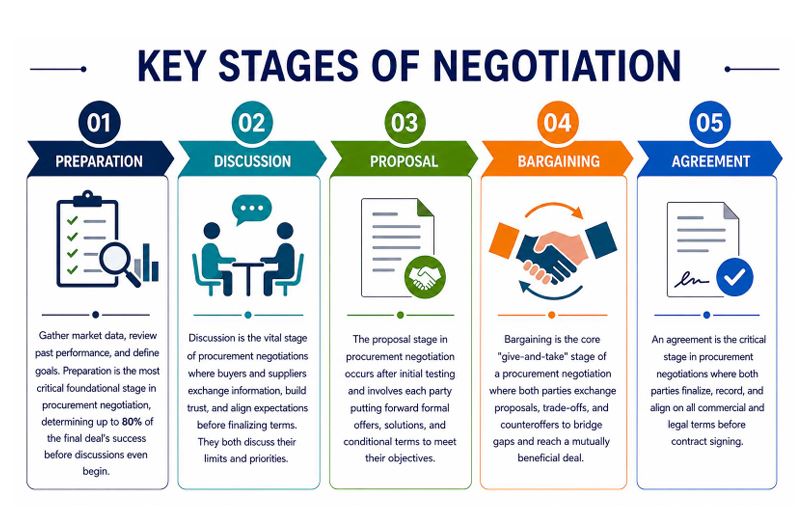
Key Stages of Negotiation
- Preparation: Gather market data, review past performance, and define goals. Preparation is the most critical foundational stage in procurement negotiation, determining up to 80% of the final deal’s success before discussions even begin.
- Discussion: Discussion is the vital stage of procurement negotiations where buyers and suppliers exchange information, build trust, and align expectations before finalizing terms. They both discuss their limits and priorities.
- Proposal: The proposal stage in procurement negotiation occurs after initial testing and involves each party putting forward formal offers, solutions, and conditional terms to meet their objectives.
- Bargaining: Bargaining is the core “give-and-take” stage of a procurement negotiation where both parties exchange proposals, trade-offs, and counteroffers to bridge gaps and reach a mutually beneficial deal.
- Agreement: An agreement is the critical stage in procurement negotiations where both parties finalize, record, and align on all commercial and legal terms before contract signing.
Essential Negotiation Strategies
- Define BATNA: Know your Best Alternative to a Negotiated Agreement so you know when to walk away.
- Map ZOPA: Find the Zone of Possible Agreement where your needs overlap with the supplier’s capacity.
- Trade, Don’t Concede: Ask for a reciprocal gain whenever you give up a point..
- Market Expansion: Sourcing locally in a target country can help businesses better understand local consumer preferences and lower entry barriers for their own products.
- Sustainability Advancements: Global sourcing provides access to regions rich in renewable resources or specialized eco-friendly production techniques.
Key Challenges in International Procurement
Navigating global markets requires managing complex, cross-border variables that can severely impact the bottom line. Expanding the supply chain across borders introduces several logistical, financial, and cultural complexities.
- Logistics and Supply Chain Complexity: Long-distance shipping often leads to lengthy transit times and unpredictable delays due to port congestion or route blockages.
- Regulatory and Compliance Hurdles: Navigating diverse international trade laws, tariffs, and ever-changing import/export restrictions requires significant legal expertise.
- Financial Risks: Exchange rate volatility can suddenly inflate procurement costs and squeeze profit margins.
- Cultural and Language Barriers: Differences in business etiquette, negotiation styles, and primary languages can lead to critical miscommunications regarding quality or contract terms.
- Geopolitical Instability: Trade wars, political unrest, or sudden sanctions can render entire sourcing regions inaccessible overnight.
- Quality Control Challenges: Maintaining consistent standards is difficult when you lack direct, on-site visibility into a foreign supplier’s operations.