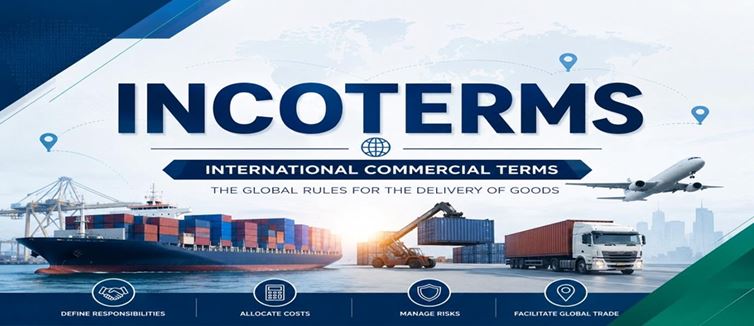
Incoterms (International Commercial Terms) are standardized trade rules published by the International Chamber of Commerce. They define buyer and seller responsibilities in supply chains, specifically the transfer of risk, logistics costs, and customs formalities. The rules apply across domestic and international transactions.
Understanding how to allocate these responsibilities helps procurement and supply chain teams calculate true landed costs and avoid costly disputes.
Core Functions of Inco Terms
Incoterms answer three fundamental questions in a supply chain contract:
- Cost: Which party pays for freight, export/import clearance, and insurance?
- Risk: Where does the liability for loss or damage transfer from the seller to the buyer?
- Logistics: Who is responsible for arranging transport, loading, and unloading?
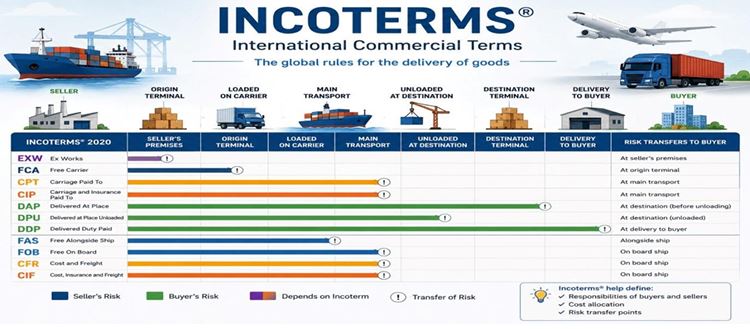
The 11 Incoterms (Incoterms 2020)
The rules are divided into two main categories based on the mode of transport:
Rules for Any Mode of Transport (Multimodal)
These apply to any transport method, including road, rail, air, and sea.
- EXW (Ex Works): Maximum buyer responsibility. The seller simply makes goods available at their facility. The buyer handles all loading, transport, export/import clearance, and assumes all risk from the moment of pickup.
- FCA (Free Carrier): The seller clears the goods for export and delivers them to a carrier nominated by the buyer at a named place. Risk transfers upon handover to the carrier.
- CPT (Carriage Paid To): The seller pays for the freight to the named destination, but risk transfers to the buyer as soon as the goods are handed to the first carrier.
- CIP (Carriage and Insurance Paid To): Like CPT, but the seller must also purchase cargo insurance.
- DAP (Delivered at Place): The seller handles all transport and assumes risk until the goods reach the named destination, ready for unloading. The buyer is responsible for import customs clearance and unloading.
- DPU (Delivered at Place Unloaded): The seller delivers the goods and unloads them at the named destination. The seller handles all costs and risks until the goods are placed at the buyer’s disposal at the destination terminal.
- DDP (Delivered Duty Paid): Maximum seller responsibility. The seller covers all costs and risks to the buyer’s door, including import duties, taxes, and customs clearance.
Rules for Sea and Inland Waterway Transport
These are intended strictly for maritime and inland waterway transport, typically for bulk cargo.
- EXW (Ex Works): Maximum buyer responsibility. The seller simply makes goods available at their facility. The buyer handles all loading, transport, export/import clearance, and assumes all risk from the moment of pickup.
- FCA (Free Carrier): The seller clears the goods for export and delivers them to a carrier nominated by the buyer at a named place. Risk transfers upon handover to the carrier.
- CPT (Carriage Paid To): The seller pays for the freight to the named destination, but risk transfers to the buyer as soon as the goods are handed to the first carrier.
- CIP (Carriage and Insurance Paid To): Like CPT, but the seller must also purchase cargo insurance.
- DAP (Delivered at Place): The seller handles all transport and assumes risk until the goods reach the named destination, ready for unloading. The buyer is responsible for import customs clearance and unloading.
- DPU (Delivered at Place Unloaded): The seller delivers the goods and unloads them at the named destination. The seller handles all costs and risks until the goods are placed at the buyer’s disposal at the destination terminal.
- DPU (Delivered at Place Unloaded): The seller delivers the goods and unloads them at the named destination. The seller handles all costs and risks until the goods are placed at the buyer’s disposal at the destination terminal.
- DDP (Delivered Duty Paid): Maximum seller responsibility. The seller covers all costs and risks to the buyer’s door, including import duties, taxes, and customs clearance.
Rules for Sea and Inland Waterway Transport
These are intended strictly for maritime and inland waterway transport, typically for bulk cargo.
- FAS (Free Alongside Ship): The seller places the goods alongside the vessel at the named port of shipment. The buyer assumes all costs and risks from that point onward.
- FOB (Free on Board): The seller clears the goods for export and delivers them on board the vessel at the named port. Risk and cost transfer to the buyer once the goods cross the ship’s rail.
- CFR (Cost and Freight): The seller pays the costs and freight to bring the goods to the destination port. However, risk transfers to the buyer once the goods are loaded on the vessel.
- CIF (Cost, Insurance, and Freight): Like CFR, but the seller is also required to buy minimum insurance coverage for the goods during transit to the destination port.