Agentic AI in procurement transforms traditional, reactive purchasing into autonomous, proactive workflows by deploying AI agents that set goals, create plans, and execute complex tasks (like RFPs, negotiations, and risk assessment) with minimal human oversight. These agents integrate across systems, enabling end-to-end automation of the source-topay process.
Most Agentic AI systems currently operate as “human-in-the-loop” systems, ensuring that AI agents handle routine actions while requiring human approval for critical, high-value decisions, or exceptions. This structure provides control and trust while accelerating daily work.
Unlike Gen AI, which only assists with content generation (like drafting an email), or traditional AI, which merely analyses data, Agentic AI acts as “digital workers”. It can:
- Act Autonomously: Initiate tasks like launching sourcing events or processing invoices without human input for every step.
- Orchestrate Workflows: Manage multi-step processes, such as identifying a need, scanning suppliers, and sending purchase orders (POs).
- Reason and Adapt: Use large language models (LLMs) to reason through complex problems (e.g., assessing supplier risk) and adjust strategies in real time based on changing conditions.
Key Use Cases in Procurement
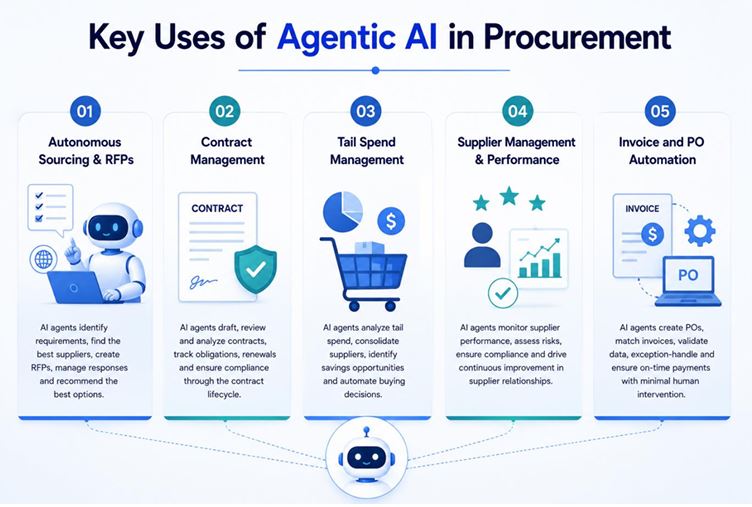
- Autonomous Sourcing & RFPs: Agents can intake business requirements, search for suppliers, conduct RFPs, evaluate responses, and recommend award winners.
- Contract Management: AI agents compare drafted contracts against company policy, identify risks, and suggest negotiation points.
- Tail Spend Management: Agents can automatically identify and manage highvolume, low-value “tail spends” by grouping purchases and finding better suppliers.
- Supplier Management & Performance: Continuous monitoring of supplier risk, news, and performance, with proactive alerts or corrective actions.
- Invoice and PO Automation: Automated three-way matching of invoices, receipts, and POs, resolving mismatches independently.
Benefits of Agentic AI
- Cost Savings: Identifying cheaper alternatives and lower-cost suppliers, as well as optimizing delivery routes, significantly reduces costs.
- Unmatched Efficiency: Freeing procurement teams from transactional tasks allows them to focus on strategic sourcing and innovation.
- Enhanced Speed: Drastically reduces the time needed for tasks like supplier evaluation and contract reviews.
- Improved Accuracy: Reduces human errors in data classification, invoice matching, and risk assessment.
Future Outlook
The future of Agentic AI is transitioning from passive chatbots to autonomous digital workforces capable of independent planning, tool usage, and multi-agent collaboration. By 2028, these systems are projected to drive massive economic value by executing up to 15% of day-to-day work autonomously across the enterprise