
Most procurement teams think that by analysing spend they’re managing it.Though dashboards and reports offer plenty of insights. But unless those insights lead to action and outcomes, they’re just observation. Understanding the difference between spend analysis and spend management is very important. If spend analysis is about understanding your spend, spend management is about controlling it—proactively. In today’s environment of inflation, geopolitical issues, supply chain disruptions, uncertainties in sourcing and supplier reliability, knowing what happened in past isn’t enough. Organizations need platform & practices to enable them to take real-time decisions in future. Let’s explore the key differences between Spend Analysis & Spend Management.
What Is Spend Analysis?
Spend Analysis, also known as spend analytics, is the process of collecting, cleansing, classifying and visualizing procurement data. It involves reviewing historical spending patterns to answer crucial financial questions, enabling businesses to understand where money is being spent, with whom, and how to gain better value for their investments. Spend analysis pinpoints the reasons behind the spending and works on ways to minimize them effectively. Spend analysis aims at enhancing business efficiency by reducing costs wherever possible. And this can be achieved by bringing in specific improvements.
👉Spend Analysis Process
A spend analysis process helps in cost reduction through identifying savings opportunities, improved efficiency by streamlining procurement processes and eliminating waste, enhanced risk management by identifying supply chain vulnerabilities and ensuring compliance, and better strategic decision-making through increased spend visibility and data-driven insights into supplier performance and contract compliance. Here’s what it typically involves.
1. Identification of Data Sources
Pulling data from multiple business units, platforms and systems to get a complete picture of organizational spend.
2. Data Collection and Consolidation
Aggregating procurement data across categories, geographies and entities into a centralized repository.
3. Data Cleansing
Removing duplicates, fixing errors and standardizing formats so that spend data is reliable and usable.
4. Supplier Normalization
Mapping supplier names across business units, identifying parent–child relationships and consolidating entries to show true supplier exposure.
5. Categorization
Classifying spend using standard or custom taxonomies, such as UNSPSC, to enable meaningful category-level insights.
6. Analysis
Visualizing trends, identifying anomalies and spotting fragmentation or tail spend opportunities.
What is Spend Management?
Spend management is the practice of controlling, analysing, and optimizing an organization’s expenditures to achieve strategic goals, maximize value, and ensure efficiency. Unlike spend analysis, which reveals what happened, spend management drives what happens next. It connects insights to action across sourcing, contracting, budgeting and supplier performance.
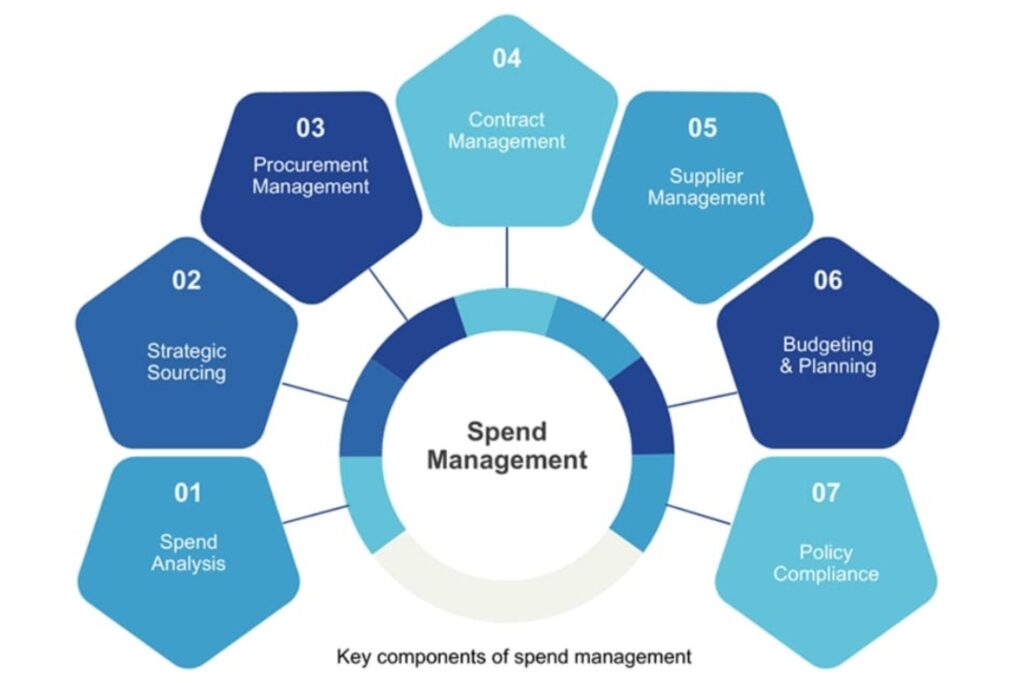
👉Key Components of Spend Management
Effective spend management solutions include several integrated capabilities that span the procurement lifecycle:
1. Spend Analysis
Ongoing spend visibility and analysis to detect trends, risks and opportunities.
2. Strategic Sourcing
Using insights to prioritize sourcing events, consolidate suppliers, and capture savings
opportunities.
3. Procurement Management
Embedding workflows and controls into day-to-day purchasing to align with
organizational goals.
4. Contract Management
Ensuring purchases are tied to negotiated terms and highlighting off-contract spend.
5. Supplier Management
Linking supplier performance and risk metrics to actual spend patterns.
6. Budgeting and Planning
Providing real-time visibility into budget consumption and future obligations.
7. Policy Compliance
Enforcing procurement policies through alerts, routing rules and automated checks.