What is Contract Management in Procurement?
Contract management refers to the process of managing contracts throughout their entire lifecycle—from creation to renewal. The primary goal of the contract management is to ensure all parties fulfil their contractual obligations efficiently and effectively.
Procurement contract management is the systematic process of creating, executing,
and analysing contracts to maximize operational/financial performance and minimize risk. It involves overseeing the procurement activities and ensuring they are aligned with the terms and conditions of the contracts –including timings, deliverables, compliance requirements etc.
Contract management is crucial in procurement activities as it protects the interests of both buyer & seller throughout the procurement process. It helps in mitigating risk, ensures compliance and more.
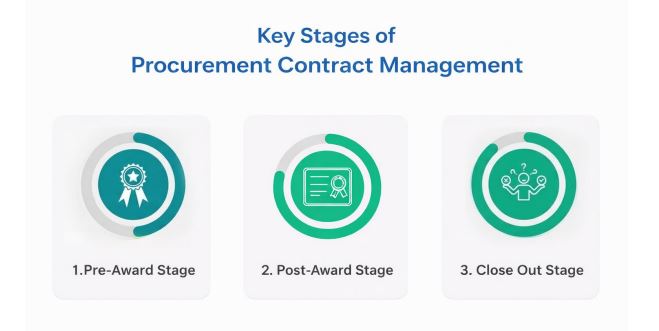
What Are the Key Stages of Contract Management in Procurement?
The key stages of contract management in procurement follow a structured contract
lifecycle, which can be broadly divided into Pre-Award, Post-Award (execution), and
Close-Out stages.
o Pre-Award Stage
The pre-award stage refers to the initial phase of the procurement process. It
involves the activities such as.
– Need assessment.
– Supplier Selection and Negotiation.
– Contract drafting & approval
o The post-award stage
In procurement occurs after the contract has been awarded. It
involves activities such as
– Contract execution and implementation
– Performance monitoring of the contract
– Contract Administration and Relationship Management
o Close-Out Stage
– Contract renewal, amendments or termination.
– Contract closeout and evaluation.
Challenges and Risks in Procurement Contract Management
Challenges and risks in procurement contract management include supplier
reliability, supply chain disruptions, poor data visibility, regulatory and compliance
issues, and manual processes that lead to bottlenecks. Other risks involve cost
overruns, missed obligations, inadequate risk management, and ineffective
communication or collaboration with suppliers.
Challenges
- Supplier reliability: Poor vendor performance, quality issues, and dependence on
single suppliers. - Manual processes: Inefficient, time-consuming, and error-prone manual tasks lead
to bottlenecks in approvals, reviews, and data management. - Data and visibility: Lack of accurate data and contract visibility across disconnected
systems makes it difficult to track progress, find information, and monitor risks. - Communication and collaboration: Poor internal communication and weak
collaboration with suppliers hinder effective decision-making and lead to
misunderstandings. - Contract standardization: A lack of standardized contract templates can create
inconsistencies and increase complexity. - Risk identification: Failing to identify risks like pricing anomalies or performance
issues early in the process.
Risks
- Supply chain disruption: Unexpected events like natural disasters or geopolitical
conflicts can halt the supply chain. - Cost overruns: Ineffective management can lead to scope creep, unexpected costs,
and an inability to maximize contract value. - Compliance and regulatory breaches: Non-compliance with evolving regulations
can result in legal penalties and reputational damage. - Missed obligations and renewals: Difficulty tracking contract terms can lead to
missed deadlines, missed obligations, and unwanted automatic renewals. - Data security: The exchange of sensitive data in procurement processes creates
vulnerabilities if not properly managed. - Price volatility: Market dynamics, such as price fluctuations and economic
uncertainty, can impact budgets. - Poor performance: Failure to monitor supplier performance can result in poor
quality and unmet expectations.