
Risk Management in Procurement
A risk can be defined as an uncertain outcome (either positive or negative) that may affect the procurement process at any time. All procurement is subject to risk. Managing risk in procurement is a very tricky business and it is a continuous process. Risks like price volatility, delivery delays, supplier bankruptcy, geopolitical instability etc. can occur at any time and impact the whole procurement process badly. To mitigate these risks, we have to develop strategies like supplier diversification, robust contracts, contingency planning, strong supplier relationships etc. for minimizing the negative impacts.

Why is Risk Management important?
Effective management of risk helps to improve performance by contributing to:
- Identifying potential risks such as delivery delays or poor-quality products reduces the costs associated with emergency buying
- Helps to manage disruptions such as logistical, environmental, or geopolitical factors which can create significant bottleneck in operations
- Helps to reduce the chances of receiving faulty materials
- Ensures adherence to all compliances
- Better management at all levels through improved decision making
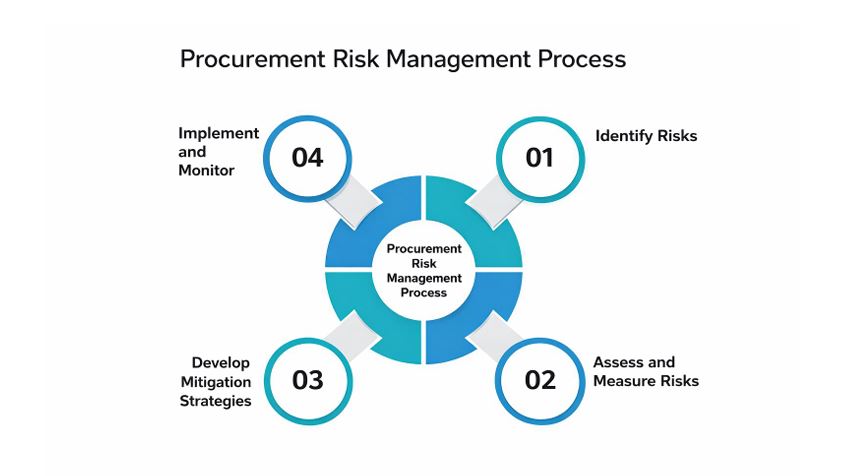
Key steps in Procurement Risk Management
Identify Risks
Risk identification is the first step in managing risk in procurement. Procurement risk identification involves recognizing internal (micro) and external (macro) threats to the supply chain to minimize disruptions.
- Micro Factors: These risks are typically internal of the organisation and can include internal changes within the buying company, change management, supplier performance, technological problems, contractual problems etc.
- Macro Factors: These are risks outside of the organisation that can impact procurement activity. These can be environmental risks, economic risks, technology, social, political, legal, ethical, and demographical risks.
Assess and Measure Risks
Next step is evaluating the likelihood of these risks occurring and their potential impact, categorizing them as high, medium, or low to prioritize action.
Develop Miligation Strategies
After assessing the risk, you have to create plans to address identified risks:
- Avoidance: Eliminate the risk by choosing a different approach or supplier.
- Transfer: Shift the risk to a third party, such as through insurance or contractual clauses.
- Reduction: Implement actions to lower the probability of the risk occurring, like implementing quality controls or diversifying suppliers.
- Acceptance: For low-impact or low-probability risks, accept them or take minimal action.
Implement and Monitor
Implementation of the strategies and continuous monitoring of the same plays a very vital role in risk management. You also have to review the strategies on regular basis and update the risk management plan accordingly.
Here are few common Procurement Risks
- Supplier-related risks: Financial distress, poor quality, or failure of a key supplier.
- Market-related risks: Price volatility, supply shortages, or cost increases.
- Operational risks: Logistics disruptions, quality control failures, poor contract management or issues with e-procurement systems.
- Geopolitical and Environmental risks: Political instability, natural disasters, or changes in trade regulations.
- Compliance risks: Non-compliance with legal regulations or violation of environmental, social and governance (ESG) standards.
- Cybersecurity risks: Breaches or disruptions in the increasingly digital procurement landscape.